


How does the capacitance of an aluminum electrolytic capacitor change when exposed to consistently high temperature and continuous voltage for several years?
This question was posed by a customer who required an electrolytic capacitor for a particularly long-lasting industrial application. However, the usual datasheet specifications for lifespan were insufficient for component selection. The crucial factor was how stable the actual capacitance would remain over a very long operating period.
FROLYT therefore investigated the capacitance change of selected aluminum electrolytic capacitors in a continuous voltage test at 105 °C.
Long-term Test under Continuous Voltage at 105 °C
The focus of the investigation was the aluminum electrolytic capacitor FROLYT ERH 100 µF / 200 V with the dimensions Ø 16.5 × 30 mm.
The result:
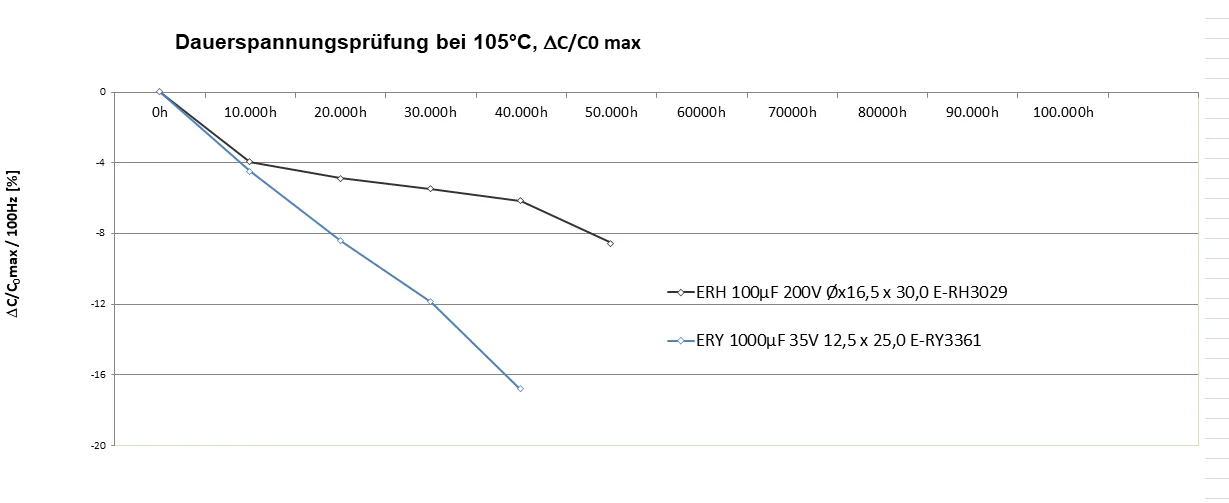
Even after around 50,000 hours under continuous voltage at 105°C, the capacitance change is less than 9%.
A test period of 50,000 hours corresponds to more than 5.7 years of uninterrupted operation – at a constant ambient temperature of 105°C.
The investigation thus provides concrete measurement data on the long-term stability of the tested electrolytic capacitor.
Capacitance Change over 50,000 Hours
The measured values show that the capacitance of the tested FROLYT ERH changes only slowly over a long period:
| Test Duration at 105 °C | Capacitance Change |
|---|---|
| 10,000 hours | approx. 4% |
| 30,000 hours | approx. 5.5% |
| 40,000 hours | approx. 6% |
| 50,000 hours | less than 9% |
Particularly relevant is not only the final value after 50,000 hours. The course of the measurement curve also shows a low capacitance change over a long period.
For developers and designers, this means a better basis for assessing the electrical behavior of a capacitor within a long-lasting circuit.
Comparison with Market-Standard Long-Term Specifications
Comparable datasheet specifications from other suppliers sometimes specify capacitance changes of up to 20% after 20,000 hours.
The tested FROLYT ERH 100 µF / 200 V remains below a capacitance change of 9% even after a significantly longer test period of approximately 50,000 hours.
The comparison clarifies: For demanding industrial applications, not only the specified lifespan of an electrolytic capacitor is relevant. Equally important is the question of how stable its electrical characteristics remain during this time.
Long-term Behavior of Compact Electrolytic Capacitors
The more compact FROLYT ERY 1000 µF / 35 V with dimensions of Ø 12.5 × 25 mm also shows good long-term behavior under the presented test conditions.
The comparatively greater capacitance change must be evaluated in conjunction with the significantly smaller size and the differing electrical characteristics. Despite the smaller volume, the tested ERY achieves high long-term stability.
This shows that when selecting an aluminum electrolytic capacitor, several factors must be considered together:
- 1Rated capacitance and rated voltage
- 2Size and available volume
- 3Ambient temperature
- 4Electrical load
- 5Required operating life
- 6Permissible capacitance change
- 7Requirements of the respective circuit
Why Capacitance Stability is Crucial
For long-lasting industrial electronics, it is not enough for a capacitor to simply function after many years.
Equally crucial is whether its electrical properties remain within the specified tolerances. An increasing capacitance change can, for example, affect filter, buffer, DC link, or timing functions of an electronic circuit.
Long-term measurements under defined test conditions therefore provide important insights for applications where high reliability and consistent electrical performance are required.
These include, among others:
Result of the 50,000-Hour Test
The original customer question can be specifically answered for the capacitor under investigation:
Even after approximately 50,000 hours of continuous voltage testing at 105 °C, the capacitance change of the tested FROLYT ERH 100 µF / 200 V remains below 9%.
The core statement of the long-term measurement is:
50,000 hours. 105 °C. Less than 9% capacitance change.
The result shows why the nominal lifespan of an aluminum electrolytic capacitor should not be the sole consideration in component selection. For demanding applications, the long-term stability of its electrical properties is at least as important.
The mentioned results refer to the investigated capacitors and the defined test conditions. Suitability for a specific application must always be evaluated based on the actual electrical and thermal load.
Frequently Asked Questions about the Lifespan of Electrolytic Capacitors
Do you need an electrolytic capacitor for a long-life application?
FROLYT supports you in selecting a suitable aluminum electrolytic capacitor based on your electrical, thermal, and mechanical requirements.
Talk to us about your application and the required long-term stability.



Leave A Comment